


Fan spinning, coil clear
This is what a working condenser looks like. The fan pulls air through clean louvers and across the coil, and the disconnect box and conduit are doing their job quietly. Nothing here is working harder than it should.
It's the middle of a sticky Kansas summer and the outdoor unit is just sitting there, quiet, while the house gets warmer. You go check the condenser and the fan on top isn't moving at all, even though the system is running. That usually means something specific stopped it, not a general sign the unit is wearing out.
That fan is run by a motor and a capacitor that gives it the jolt it needs to start spinning. When the capacitor weakens, the motor hums but can't turn, especially on a hot afternoon when the system is working hardest. The motor itself can also fail outright after running all summer. Sometimes the fix is simpler: a tripped breaker, a stuck relay, or a layer of dirt and leaves jamming the blades. If the fan stays off while the compressor inside the unit keeps running, heat has nowhere to go, and the system can overheat and shut itself down to protect the compressor. That's worth paying attention to before it leads to a bigger repair.




You can hear the indoor blower running and feel air coming out of the vents, but it's not cold. Out at the unit the fan blade sits still, maybe you can see it from the window. Sometimes you'll hear a hum or a click from the unit trying to start. Sometimes it's dead silent except for a faint buzz. The breaker might have tripped, or the unit might feel warm to the touch near the base. If this keeps running with the fan stuck, the compressor inside can take damage that turns a simple repair into a much bigger one, and the house keeps climbing past where you want it on a hot Kansas afternoon.
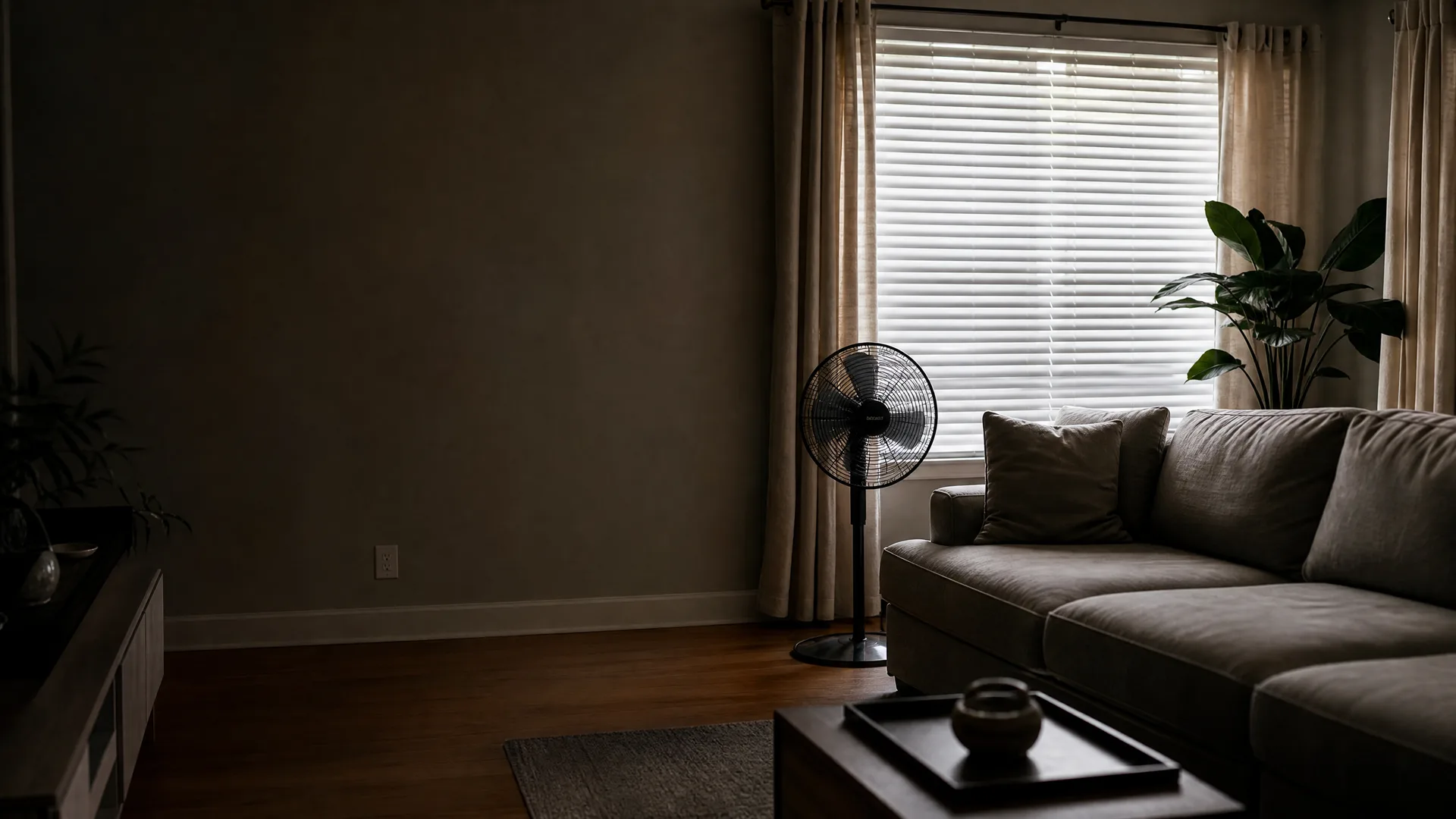
By two in the afternoon the blinds are already drawn against the sun, and the floor fan next to the couch is doing the work the AC should be doing. You've checked the vents twice now, same warm air both times. Outside, the condenser hums along like nothing's wrong, but the fan on top hasn't turned once since lunch. The dog's stretched out flat on the kitchen tile where it's coolest. Somebody's going to want a shower just to cool off before dinner. You keep the blinds shut and the fan pointed at the couch and wait it out, because outside it's pushing past ninety and the house isn't far behind it.
The thermostat calls for cooling and sends power to the outdoor unit.
The contactor closes, feeding power to the compressor and fan motor.
The run capacitor gives the fan motor its starting push.
The motor spins the blade, pulling air through the condenser coil.


When that fan stays still, the compressor is often still running inside the unit, and it heats up fast with no air moving across the coil to cool it down. Run it like that for long and you're looking at a compressor that trips off on its own protection, or one that doesn't come back at all. Meanwhile the house keeps climbing. An evening that should settle into the upper 70s inside stays stuck near 85, and with kids or older family members home all day in a Kansas summer, that's not something you can just wait out. The humidity makes it worse than the number suggests, since the air isn't getting pulled dry the way it would with the system working right. Every hour the fan sits dead is an hour the compressor runs hotter than it should, and that's the part of the system most expensive to replace. It's worth shutting the system off at the thermostat until someone's looked at it, rather than letting it keep calling for cooling with the fan not turning.


The pro who reaches out is licensed in Kansas.
No charge to send it. You decide if you hire them.

This is what a working condenser looks like. The fan pulls air through clean louvers and across the coil, and the disconnect box and conduit are doing their job quietly. Nothing here is working harder than it should.

This older unit sits against the siding with dried weeds pressing in and gravel built up around the base. If the coil behind those louvers is caked or the airflow is blocked, a fan that's already struggling has one more reason to quit.

With the fan stuck, the house stops pulling away from the heat outside and starts following it. Every hour the sun's up, the gap between indoor and outdoor temperature closes a little more. You'll feel it first in the rooms farthest from the thermostat, and by evening the whole house has given up the ground it held in the morning. The compressor still running inside that unit, straining with no air moving past it, is a repair bill that gets bigger the longer it sits.
A fan that won't spin usually comes down to one of a few parts, and knowing which one means knowing what's inside that specific unit. That's where someone local who works on these condensers all summer long matters, someone who's already seen this fan motor and this capacitor fail in houses near yours and knows which one to check first. Get matched with one licensed contractor for your situation, not a handful of companies competing for the call, and let them take it from here.


A Kansas summer averages a dew point of 64°F across June, July and August, which is the kind of air that sits on you instead of just surrounding you. That moisture load is exactly what the outdoor fan is built to help carry off, pulling air across the condenser coil so the system can wring the humidity out of the house along with the heat. With the fan stuck, none of that air is moving, so the moisture stays put. You'll notice it as a house that feels damp even where the vents are blowing, floors that seem cool and clammy, and a general heaviness in the rooms that a working system would have cleared out hours ago.
NASA POWER T2MDEW county cells weighted by homes


A run capacitor is a small part, but it stores the charge that kicks the fan motor into motion the instant the thermostat calls for cooling.
Lose that charge and the motor just sits there drawing power with nowhere to put it, which is why you can hear a hum and still see a still blade.
You pay 14.44 cents per kilowatt-hour here, right at the state average. A fan motor pulling hard against a failing capacitor, or a compressor straining with no air moving across the coil, draws more than a healthy system would, and that shows up on the next bill before the unit ever quits for good.
EIA-861 2025 statewide residential average
A fan that won't turn while the blower keeps pushing warm air through the house comes down to one of three things: the motor, the capacitor, or the contactor. You can't tell which from the kitchen. Someone has to stand at the condenser, pull the panel, and test it. Leave the compressor running without airflow across the coil much longer and the fan motor stops being the only thing you're replacing. That's the part of this that gets worse with time, not better.
What helps here is that this kind of failure is common enough in a Kansas summer that a contractor who works this equipment all season has already seen it a dozen times this year alone. They know to check the capacitor before they assume the motor is dead, because a bad capacitor looks the same from the outside but costs a lot less to fix. That order of checking is what saves you from paying for a motor you didn't need.
When you request a repair through this page, you're matched with one licensed contractor local to your part of Kansas, not a handful of companies competing for your callback. One visit, one technician who already knows what tends to fail on these units and in what order to rule it out. Whether the fan went quiet this afternoon or you've been living with warm air for three days, the fix starts the same way: someone at the unit, confirming which part failed, before anything gets replaced.
There's no charge for the request.
A fan that won't turn doesn't fix itself by waiting through another Kansas afternoon. Sending the request gets a licensed local contractor looking at your unit, someone who works on these motors and capacitors all summer and knows which one usually gives out first.