Tell us about the job
Takes about a minute. No obligation.
A contractor quoting a central AC repair in Rooks County starts by looking at what has worn from use, not from age alone. Homes in Rooks County, KS run cooling about four months a year, from June through September. The compressor starts and stops through every one of those months, and so does the condenser fan motor and the contactor that switches them. Parts that cycle that many times accumulate wear in ways that show up as refrigerant loss, contactor pitting, or a capacitor that can no longer hold enough charge to start the compressor. A contractor who skips that inspection and replaces only the obvious failed part sends the homeowner back to square one before the next summer ends.
Half the homes in Rooks County, Kansas were built in 1953 or earlier (2020-2024 ACS 5-year). Equipment that has been running in houses like these has cycled through heat and cold long enough that what a contractor finds inside an opened unit often comes down to parts that are hard to source. A capacitor or contactor is usually still available. Refrigerant fittings, control boards, or proprietary blower assemblies for older platforms are a different matter, and a contractor pulling one of those has to run down availability before the repair scope is settled.
The Parts of a Central AC a Contractor Checks First
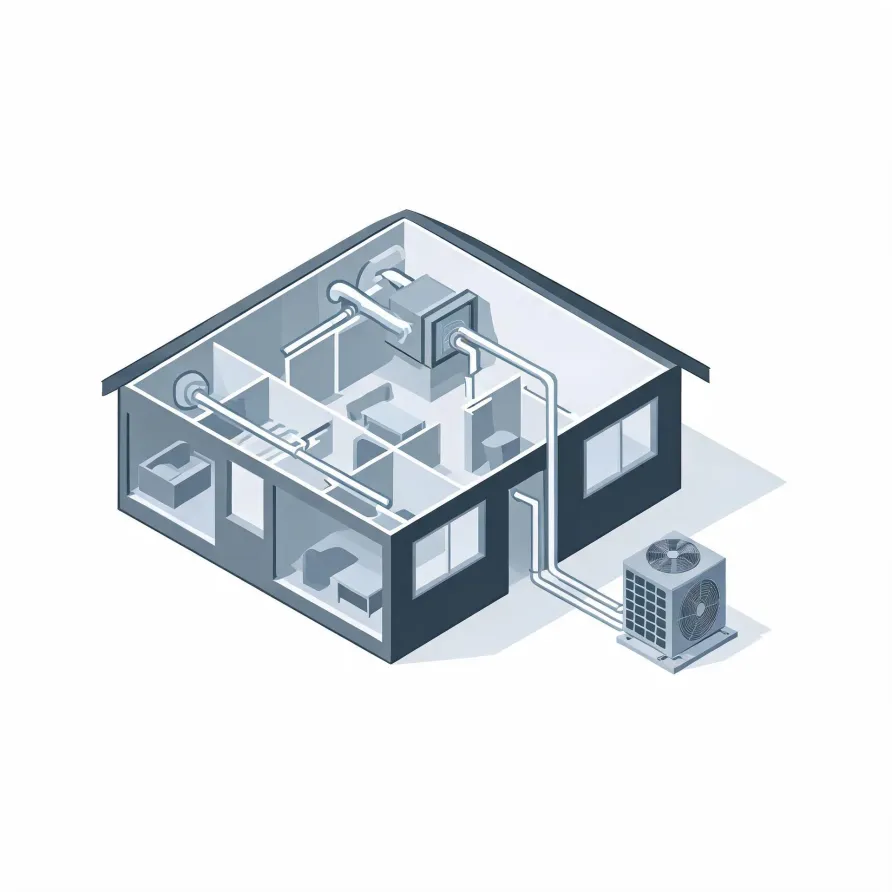
The outdoor condenser unit sits outside the house, usually on a concrete pad at ground level, and it holds the compressor and condenser coil. These are the parts a contractor reaches first when a system stops cooling, makes noise, or trips a breaker. The compressor is the most-worked component in the cabinet.
Inside the house, the air handler or furnace cabinet sits in a utility space, attic, or basement and holds the evaporator coil and the blower. The evaporator coil is a common source of trouble when airflow drops or ice appears on the unit. A refrigerant line set runs between the two cabinets, and its fittings and charge are part of what a contractor checks when the indoor and outdoor sides both look intact.
The drawing shows a typical central AC layout, and a licensed contractor determines which components apply and what condition they are in for your specific home.
Get matched in Rooks CountyRooks County, by the numbers
164 severe weather events were recorded in Rooks County, Kansas between 2015 and 2024.
NOAA National Centers for Environmental Information, Storm Events Database, bulk CSV export, events 2015-01-01 through 2024-12-31.Half the homes in Rooks County, Kansas were built in 1953 or earlier (2020-2024 ACS 5-year).
U.S. Census Bureau, 2020-2024 American Community Survey 5-Year EstimatesRooks County, Kansas holds 2,635 housing units (2020-2024 ACS 5-year).
U.S. Census Bureau, 2020-2024 American Community Survey 5-Year EstimatesOwners occupy 74.3% of the occupied homes in Rooks County, Kansas (2020-2024 ACS 5-year).
U.S. Census Bureau, 2020-2024 American Community Survey 5-Year EstimatesCodes & Standards Covering Central AC Repair in Rooks County, Kansas8 sourced rules and standards
What the repair visit looks like
Split-system central air conditioners rated below 45,000 Btu/h manufactured on or after January 1, 2023 must meet a federal minimum of 13.4 SEER2.
Split-system central air conditioners rated at or above 45,000 Btu/h manufactured on or after January 1, 2023 must meet a federal minimum of 13.4 SEER2.
Split-system central air conditioners manufactured between January 1, 2015 and December 31, 2022 had to meet 13 SEER, the metric that preceded SEER2.
Single-package central air conditioners manufactured on or after January 1, 2023 must meet a federal minimum of 13.4 SEER2.
Space-constrained central air conditioners manufactured on or after January 1, 2023 must meet a federal minimum of 11.7 SEER2.
Federal efficiency standards for split-system central air conditioners and heat pumps are set on each certified combination of outdoor unit and indoor coil rather than on the outdoor unit alone.
Residential and light commercial air conditioning and heat pump systems assembled in the field, including mini-splits and unitary systems, may not be installed on or after January 1, 2025 using a refrigerant with a global warming potential above 700.
A field-assembled system whose specified components were all manufactured or imported before January 1, 2025 carries no installation compliance date under the refrigerant restrictions and may still be installed.
Severe Weather Events in Rooks County
Weather puts a measurable load on cooling equipment. The harder a system works to hold a steady temperature against heat, humidity, and storm-driven pressure changes, the more likely it is to need repair, and that pattern is specific to this part of Kansas.
164 severe weather events, 2015–2024. Source: NOAA National Centers for Environmental Information, Storm Events Database.