AC making a loud noise in Hutchinson, KS

After you send the request, you're done searching.

Hand it off

A loud noise from your AC usually points to something loose, worn, or hitting a part it shouldn't. Rattling often means a panel has worked itself loose or debris is caught in the outdoor unit. Squealing points to the fan motor bearings or a belt, if your system still has one. Banging or clanking from the outdoor unit can mean a part inside the compressor has broken loose, which is a bigger problem. A high-pitched hiss can mean refrigerant escaping from the line. With Reno County summers running long and sticky, your system is working hard for months at a time, and that steady load is exactly what wears a bearing or shakes a panel loose. A new noise rarely fixes itself and tends to get worse the longer you run the unit. Shutting it off and having someone look at it before the next hot stretch keeps a loose part from turning into a failed one.

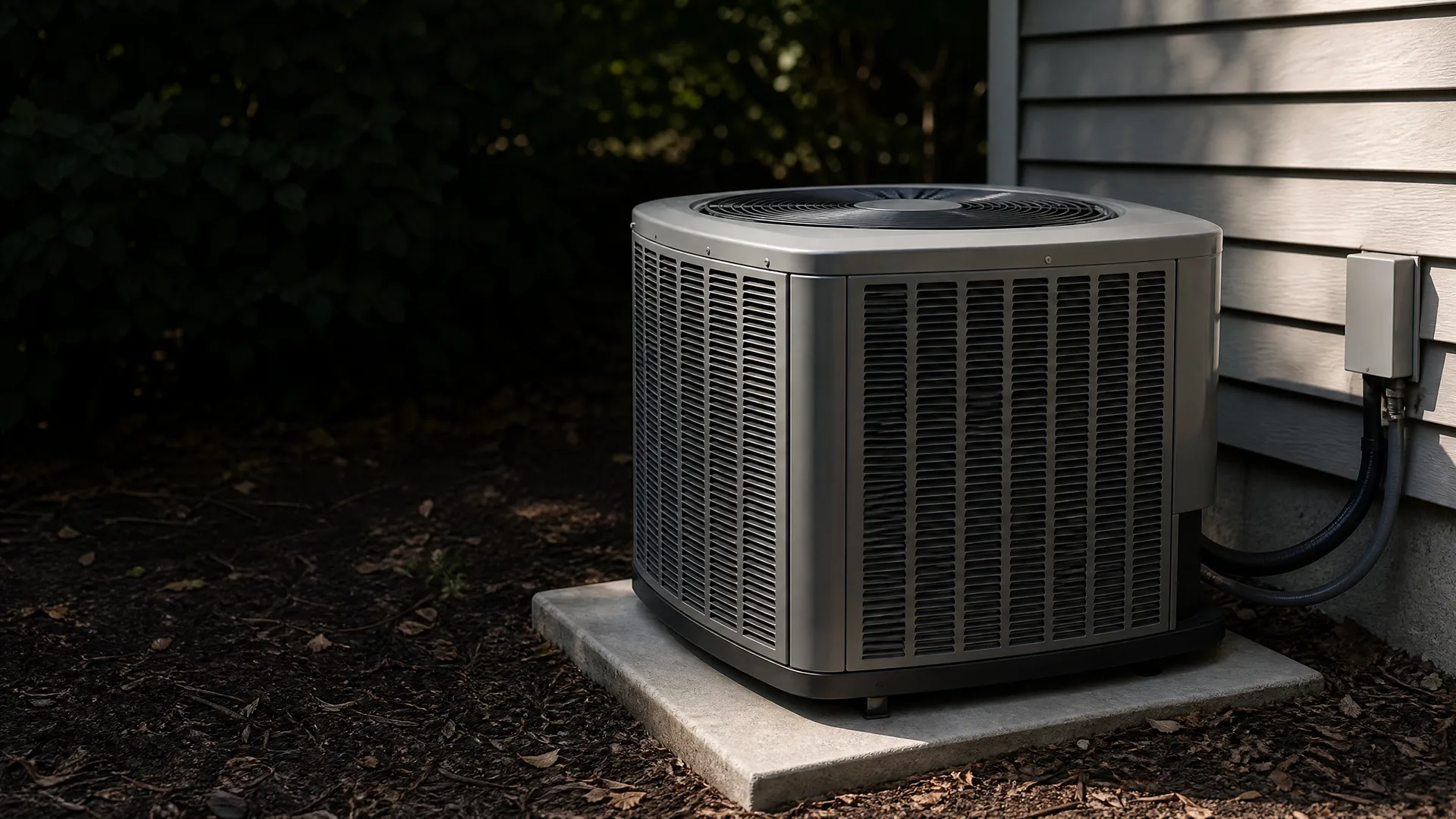
An outdoor air conditioning condenser unit on a concrete pad beside a house with horizontal lap siding, with an electrical disconnect box and conduit on the wall and a green shrub to the right.

Running quiet

This is what a healthy unit sounds like outside your house: a steady hum, maybe a soft whoosh of air through the louvers. No clanking, no squeal, nothing hitting metal on metal. If yours still sounds like this, the noise you're hearing may be coming from somewhere else, like the vents or the attic.

An outdoor air conditioner condenser unit on a concrete pad beside a house with horizontal siding and a lower concrete foundation wall, with coiled refrigerant lines at right.

Worn and noisy

Dirt built up on the panels and fan grille like this traps heat and makes the fan work harder, which can turn a quiet hum into a strain you can hear from the yard. Years of weather on the cabinet can also loosen screws and panels, giving you the rattle. Refrigerant lines left exposed at the back are worth a look too, since a line rubbing against the cabinet makes its own racket.

Why does my AC sound like this all of a sudden

You're probably noticing it most in the evening, when the house is quiet and the unit outside is running hard against the Hutchinson heat. A banging or clanking usually means something has broken loose inside the cabinet, a bent blade or a bolt that worked its way out. A high-pitched squeal gets louder the longer the unit runs. A hissing sound is different from the rest and worth paying attention to, since it can mean refrigerant escaping from the line. Left alone, a loose part can hit something else and cause real damage, and a system low on refrigerant will cool less while it works harder, which shows up on your next power bill.

A gray outdoor air conditioning condenser unit on a concrete pad beside a house with horizontal lap siding, with a wall-mounted electrical disconnect box and refrigerant lines, shrubs, mulch and lawn around it.

Clean and clear

This is what the outdoor unit should look like: fins clean, cabinet intact, nothing but air moving around it. The conduit runs straight from the unit to the disconnect box, and the ground around it is clear of anything that could get pulled into the fan. Noise stays low because nothing is loose or blocked.

An outdoor air conditioner condenser unit on a concrete pad beside a house wall with stucco lower section, horizontal siding above, and a white downspout to the right.

Worn and dirty

Years of grime have built up across the fins, and the metal shows it. Dirt packed into the coil makes the fan work harder, and a cabinet that's taken this kind of wear is more likely to have a loose panel or a part rattling inside. This is the kind of unit that starts making noise it didn't used to.

Keep Running or Shut It Off

Safe to run

  • A steady rattle from a loose panel screw won't strand you without cooling if you tighten it or have it tightened soon.
  • A soft squeal that only shows up at startup and fades is usually a belt or bearing issue that worsens slowly, not overnight.
  • If the noise hasn't changed in a day or two and the house is still cooling evenly, the unit is likely still doing its job.
  • A hum that's a little louder than usual, with air still moving fine through the vents, points to something minor like a loose fan guard.

Shut it off now

  • A grinding or metal-on-metal noise means something is hitting a part it shouldn't, and running it longer can turn a cheap fix into a compressor replacement.
  • If the noise comes with the unit short-cycling, tripping the breaker, or the air turning warm, the compressor could be struggling.
  • A loud bang on startup, followed by the unit refusing to run again, often means a capacitor has failed and shouldn't be forced to restart.
  • Any burning smell alongside the noise means power it down and call for service before you try running it again.
  • If the noise is new and getting louder by the hour, waiting it out usually costs more than catching it early.
An outdoor air conditioner condenser unit sits on a concrete pad beside a shingled house wall, surrounded by mulch, broad-leaved shrubs and a lawn in low evening light.

You're out back around seven, watering the tomatoes before it gets dark. The condenser should be pushing that steady hum you've heard all summer, but instead it's quiet except for a low rattle, on and off, like something loose knocking against the cabinet. The fan isn't turning. The light's gone gold and flat the way it does this time of evening in August, and the air coming off the unit feels warm instead of cool. You crouch down and look through the grille but can't see much with the sun behind you. Inside, you already know the house is starting to hold onto the heat it usually loses by now. You set the hose down and head in to check the thermostat, half expecting the number to have crept up already.


It's off your list after this

A noise that's gotten worse over a few days, or one that showed up loud and stayed, is worth getting a second opinion on before it turns into a unit that won't run at all. You've already got a sense of what you're hearing and what it might mean. What's harder is finding someone in Hutchinson who can look at it this week instead of next, without you calling three companies and repeating the same description of the sound each time. Send the request once and that part is handled. You won't be sorting through quotes or explaining the rattle or the squeal again to the next person who picks up the phone. With Reno County summers running long and hot, a condenser that's straining or hitting something it shouldn't isn't a problem that gets better on its own. Getting a contractor out to look at it, rather than waiting to see if the noise goes away, is the difference between a quick fix and a system that quits on you in August.

What's Actually Making That Noise

  • The compressor sits on rubber isolation feet, and when one cracks or shifts, the whole unit starts transmitting vibration into the cabinet as a buzz.
  • A contactor clicks once to start the outdoor unit and once to stop it; a chattering or buzzing contactor means the contacts inside are pitted or the voltage feeding it is unsteady.
  • The fan blade above the compressor can bend slightly from age or a stray branch, and once it's out of true it thumps against the shroud once per rotation.
  • Refrigerant lines run through the cabinet wall in rubber grommets, and a missing or worn grommet lets the copper line buzz against sheet metal as the system cycles.
  • A failing run capacitor makes the compressor or fan motor strain to start, and that strain can show up as a hard hum or a groan right at startup.
  • The reversing valve some systems use to manage refrigerant flow can stick and buzz loudly for a second or two when it switches position.

Most of these noises trace back to something small that's moved out of place, not a failing unit. The compressor sits on rubber feet, and those feet harden and crack over years of heat and cold. Once one goes, the compressor's own vibration has nowhere to absorb, so it comes through the cabinet as a buzz you can hear from the yard. The contactor is a different animal. It's a small switch that closes to send power to the outdoor unit and opens to cut it, and it should only make two sounds a day, one click to start and one to stop. If it's chattering or buzzing instead, the contacts inside are pitted, or the power coming into the unit isn't steady. The fan blade mounted above the compressor can bend from age or from a branch that got too close, and once it's slightly out of true, it strikes the shroud around it once per spin. That shows up as a steady thump timed to the fan speed. Refrigerant lines pass through the cabinet wall through rubber grommets meant to keep copper off metal. When a grommet wears through or falls out, the line buzzes against the sheet metal every time the system cycles on. A capacitor losing its charge forces the compressor or fan motor to labor through startup, and that strain often sounds like a hum or a groan right as the unit kicks on. Some systems also have a reversing valve that can stick for a second when it switches position, giving off a sharp buzz before it settles.

A woman in a dark gray sweater reclines on a couch with her eyes closed and a knit blanket over her lap, an open book resting face-down in front of her, with a lit table lamp and shelving blurred in the background.
A bearded man in a dark navy sweater over a collared shirt smiles and looks off to the side while seated at a dinner table with a glass of red wine, a lit candle, and a plate of food in the foreground of a dimly lit room.

104°F

That's the record high on record for Hutchinson. On the hottest afternoons, an AC already straining against a loose part is the one most likely to quit.

Send my request

Two spots, one problem

A loose panel and a failing bearing can sound almost the same from the yard. Finding out which one takes a hand on the unit, not a guess from the porch.

Send my request

What does it mean if my AC is buzzing but still running?

A buzzing outdoor unit that keeps running is confusing because nothing has stopped working. You're not sure if it's safe to leave alone or if it's telling you something is about to fail. The sound is steady, not getting louder or softer, and the AC still seems to be cooling the house fine despite it.

It's usually an electrical part, not the compressor itself

A steady buzz while the unit keeps running usually traces back to the contactor, the switch that sends power to the compressor and fan. When its contacts wear or pit, it can hum or buzz under load instead of sitting silent. A failing capacitor can cause the same sound, since it's what keeps the compressor and fan motor running smoothly once they start. Either part can buzz for weeks before it actually fails, and when it does, the unit usually won't restart on its own. It's not an emergency the way a dead unit is, but it's worth having checked before a hot stretch, since Hutchinson summers don't leave much room for a compressor that won't start.

An outdoor air conditioning condenser unit on a concrete pad beside a house with light vinyl siding, with electrical conduit running to a wall-mounted disconnect box and a shrub in mulch to the right.
Before you get your air conditioner repair
A gray outdoor air conditioning condenser unit on a composite pad beside a house with horizontal lap siding, with a wall-mounted disconnect box, refrigerant lines, and a wooden fence and shrubs to the left.
After you get your air conditioner repair

Cooling runs May through September

Your AC here runs from May through September, close to five months out. A noise that starts small in May has all summer to get worse under that kind of use. Whatever's loose or rubbing now is worth catching before July asks more of it.

NOAA nClimDiv 1991-2020

A smiling bearded man in a dark blue henley shirt sits leaning back on a light grey sofa in a living room, with a bowl of popcorn on a wooden coffee table and a large window behind him.
A bearded man in a dark quarter-zip sweater sits smiling on a brown sofa in a dimly lit living room, with a bowl of popcorn and a mug on a table in the foreground and a potted plant near a window behind him.
A smiling man with graying dark hair and a beard, wearing an olive sweater, sits on a sofa in a living room beside a bowl of popcorn on a wooden table.
A smiling man in a dark green henley shirt sits on a gray sofa in a living room with a lit table lamp, wooden shelving unit, and a bowl of popcorn in the foreground.
A two-story house with tan horizontal siding and a dark shingled roof, fronted by a mowed lawn, trimmed shrubs, leafy trees on both sides, and a concrete walkway leading from a wet sidewalk to the white front door.

Summer air here carries a dew point around 63°F, heavy enough that your AC is pulling moisture out of the air on top of cooling it, running longer stretches than it would in drier heat. That extra runtime matters for a unit already making noise. A loose panel or a worn bearing gets more hours to rattle and wear under long cycles than it would in a quick burst of cooling. If the noise started faint, this is the kind of stretch that turns it into something louder. Source: NOAA climate normals for Reno County.

NASA POWER T2MDEW

A closed laptop and a ceramic mug of dark coffee sit on a wooden table, with a blurred kitchen counter, potted plant, wooden utensils and cutting boards, and a large window in the background.

What the noise is telling you

A rattle is something loose. A squeal is a motor or belt. A buzz is usually electrical, at the contactor or a weak capacitor. A bang is something that's already broken free inside the cabinet. None of these go away on their own, and none of them get quieter as the summer goes on.

You don't need to know which one it is before you ask for help. You've heard it, you can describe it, and that's enough to start. What you don't have to do is spend an evening searching for a contractor near Hutchinson, calling a few numbers, explaining the same sound three different times, then sitting with a stack of quotes trying to guess which one is fair. Send the noise in once, and the search for someone to listen to it is no longer yours to do.

A speckled beige ceramic vase holding thin dried branches sits on a round wooden table near a window with sheer curtains, with a dark upholstered chair and draped blanket blurred in the background.
An outdoor air conditioner condenser unit on a concrete pad beside a house with horizontal lap siding, with an electrical disconnect box and conduit on the wall and dark mulch and shrubs around it.

Stop chasing an air conditioner pro

Step 1 of 3: Equipment